
The Curious Incident of the dog in the night

The Curious Incident of the Dog in the night
Milton Keynes (UK Tour)
(Review Complete)

"A relaxed play, both in atmosphere and approach"
6th Sept' 2026
It was announced at the start as a relaxed play, both in atmosphere and approach, as this newly reimagined production of The Curious Incident of the Dog in the Night-Time opened the latest leg of its national tour at Milton Keynes Theatre. Simon Stephens' adaptation of Mark Haddon's bestselling novel remains an affecting family drama wrapped inside a murder mystery, although this version's minimalistic staging and slow pace make it less electrifying than the celebrated original.
The story begins with the discovery of Wellington, a neighbour's dog, killed with a garden fork. Chris Boone, a mathematically gifted teenage girl who finds people and their contradictions much harder to understand than numbers, decides to identify the culprit. What starts as a carefully organised investigation gradually exposes lies within Chris's own family and propels her beyond the boundaries of the world she knows.
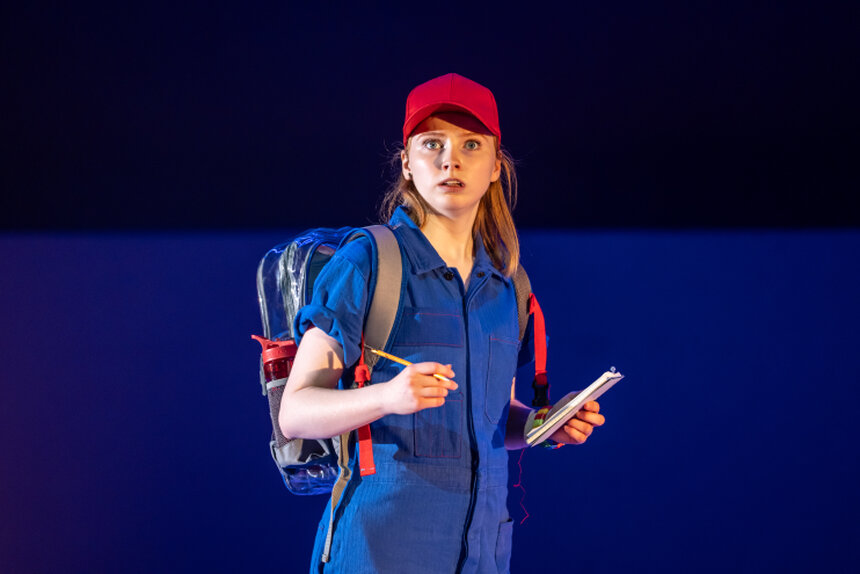
The production's most significant change is its decision to make the lead character a girl. In Mark Haddon's novel and the original stage adaptation, the protagonist was a boy called Christopher Boone. Here, Christopher becomes Chris and is played at this performance by Alex Keenan. Keenan and alternate Imi Price are the first women to take on the role in the play's production history, giving this familiar story a fresh perspective.
This is more than a superficial casting change. A teenage girl's vulnerability when travelling alone, particularly during Chris's overwhelming journey to London, introduces subtly different social pressures. At the same time, the production wisely avoids labouring the point or rewriting Chris into an entirely different person. Her passion for mathematics, literal interpretation of language and determination to uncover the truth remain at the centre of the drama.
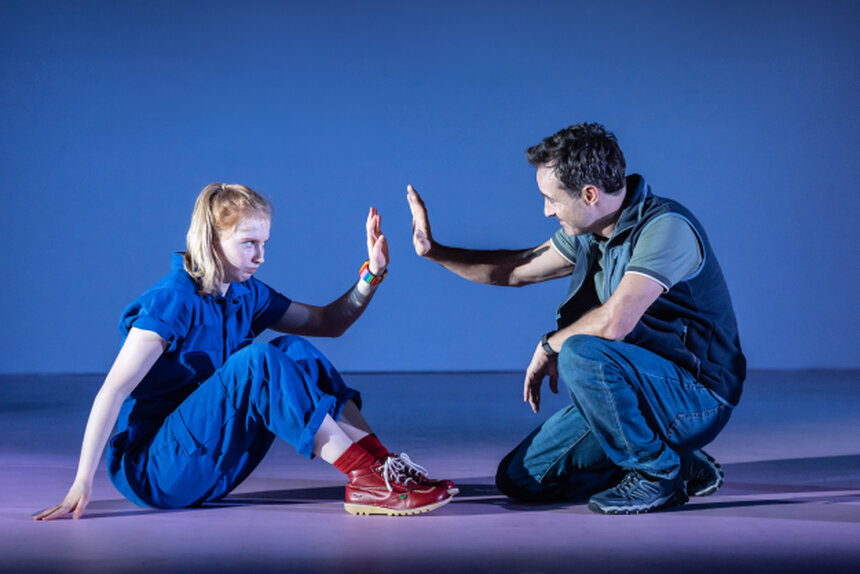
Alex Keenan gives a focused and physically committed performance. Her Chris is guarded, precise and often intensely still, but flashes of wit and stubborn courage prevent the character from becoming one-note. Keenan handles the emotional escalation convincingly, particularly as Chris learns that the adults she depends upon cannot always be trusted. The performance is carefully controlled, though that restraint occasionally contributes to the evening's subdued energy. Moments that should feel dangerous or exhilarating do not always ignite as fully as they might.
As Judy Boone, Charlie Brooks brings considerable emotional weight to a mother whose love for her daughter is complicated by frustration, guilt and an inability to cope. Brooks resists turning Judy into either a villain or a victim. Instead, she presents a recognisably flawed woman who has made painful choices and must live with their consequences. Judy's letters to Chris are among the production's most moving passages, allowing Brooks to reveal warmth and regret without tipping into easy sentimentality.
Joe McFadden is equally strong as Ed Boone. His Ed is affectionate and frequently funny, but there is always tension beneath the surface. McFadden communicates the exhaustion of a father trying to protect his child while carrying secrets that threaten to destroy their relationship. When those secrets emerge, his mixture of shame, anger and desperation is uncomfortable to watch in the best sense. The scenes between McFadden and Keenan provide the play with its strongest emotional pulse.
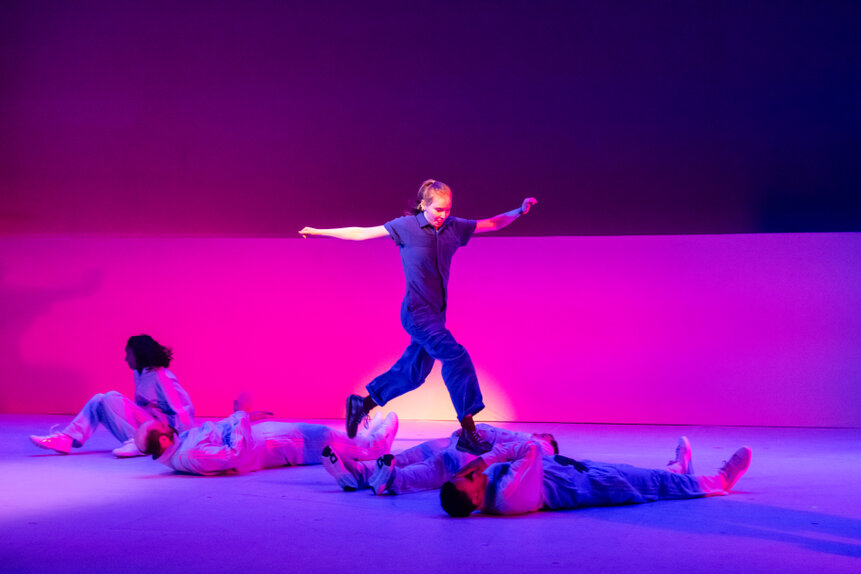
The supporting company work with discipline, slipping between teachers, neighbours, police officers and strangers encountered on Chris's journey. Their movement around Chris conveys a world that can become crowded and confusing, although the ensemble sequences do not always achieve the overwhelming intensity required. At times, the figures surrounding Chris seem merely busy rather than genuinely threatening.

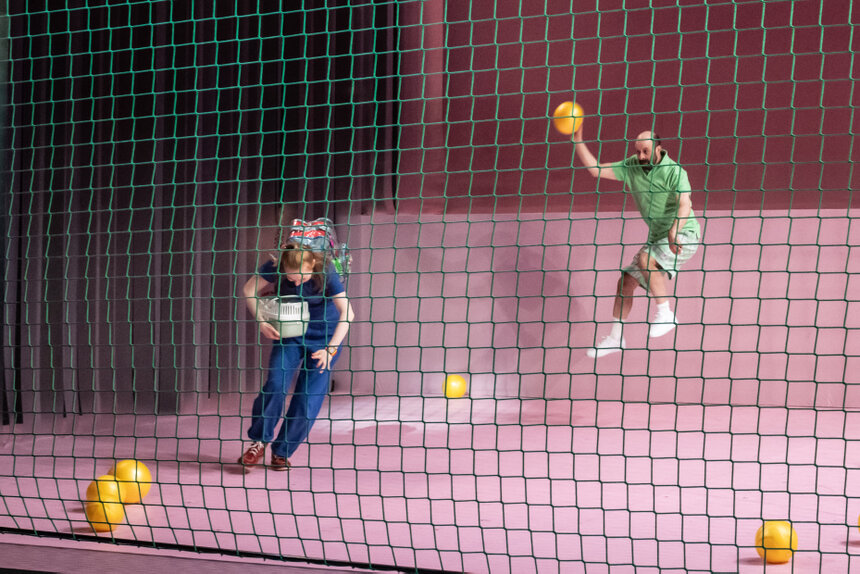
The biggest departure from the original National Theatre production is the minimalistic staging. Marianne Elliott's original staging became famous for its graph-paper-like walls, projections, grids of light and visual effects that drew the audience into Christopher's thought processes. Its design did not merely decorate the action; it made the character's perception feel immediate and theatrical.
This touring version is much more stripped back. The simpler design gives the actors space and may make the story easier to follow, but it also removes some of the visual language that once made the play so distinctive. Chris's relationship with mathematics, patterns and spatial logic is described rather than fully experienced. The journey through stations and onto the London Underground should engulf the audience in Chris's sensory overload; here, it is clear and competently constructed but not especially immersive.
Minimalism can sharpen attention and encourage the imagination, but in this case it too often feels like absence rather than reinvention. Those unfamiliar with the original production may find the staging clean and accessible. Those who remember its astonishing technical and physical storytelling are likely to miss the sense of discovery and sensory excitement that transformed the play into an event.
The slow pace compounds the problem. The production takes time to establish relationships and allows emotional scenes room to breathe, which suits the quieter exchanges between Chris and her parents. However, the first act is frequently too measured, and the investigation into Wellington's death lacks forward momentum. Repeated pauses and transitions interrupt the tension instead of building it.
The pace improves when Chris leaves home, but even the journey to London feels less urgent than it should. This section ought to mark a thrilling expansion of the play's world, combining fear with a remarkable act of independence. Keenan conveys Chris's distress and determination, yet the direction rarely gives her enough momentum to make the journey feel truly perilous. A tighter rhythm would strengthen both the mystery and the family drama.

There is still much to admire. The decision to recast Christopher as Chris is thoughtful and dramatically valid, while Keenan, Brooks and McFadden form a persuasive, painfully imperfect family. The production also retains the play's humour, including the gap between what Chris says and what the adults around her think she means. Its emotional message remains powerful: courage is not the absence of fear but the decision to continue through it.
Yet this Curious Incident is more affecting than astonishing. It offers an interesting new perspective on its protagonist and three committed central performances, but the minimalistic staging and slow pace dilute the theatrical force of the story. Opening this leg of its tour at Milton Keynes Theatre, it is a considered and accessible revival, although one that rarely matches the invention or urgency associated with the original.
A sincere and well-acted reimagining with a compelling change at its centre, held back by sparse staging and a pace that sadly too often blunts the drama.
Reviewer: Mark Bilsby.
Photography: Copyright at source
We are Gifted tickets so that in return we may give an honest review. All comments are those of the reviewer and theirs alone.